Controlling dynamics in each hand independently

Some viewers have said, ” I have a problem that my left hand plays as loudly as my right hand. Could you please tell me how to control my left hand’s strength?”

Here’s one of my answers:

Bring your mom’s/your  kitchen scales next to your piano. Using your RH, press on the scales until it goes as far down as it can (maybe to 1kg or 1.5kg). Using your LH, press it down lightly…maybe to 300g. Now, at the piano, play each hand with the same amount of force and listen to how loud it sounds. To make a loud sound, you need to “push” the keys in FASTER. For softer sounds, you relax when pressing the keys. The trick is to do this at the same time in a different hand.

Then practise a simple exercise first, separate hands, then together eg. C D E F G F E D C, visualising RH pushing the keys further in than LH for EVERY NOTE. Most people can do the first note, then they forget the others. Play slowly and carefully, making every RH note much louder than LH. If you practise like this every day, you’ll soon learn how to control the tone in your hands independently.

Here’s another answer:
To train yourself to play varying dynamics, the kitchen scales will be the best aid 🙂
Sit at your piano, with the scales nearby (preferably at the same level as the keyboard) Put one hand on it as you would on the piano, then start putting varying pressure on it. Use that same degree of pressure/weight/strength on the piano and see how loud it sounds. Learn exactly how many grams you’d have to “push” to make a pp, p, mp, mf, f, ff. Then learn how to create crescendo and diminuendo while playing your fingers one after another – 1 2 3 4 5 4 3 2 1 (repeat), 1 3 5 3 1 3 5 3 1 (repeat) and in all kinds of patterns. Alternate just 2 fingers, accenting one and making the other softer. Then increase the number of fingers involved. Basically, you want to learn how to control each finger to produce whatever tone you need from it. 
 
Hanon technical exercises are good for this. They are repetitive and easy enough for you to concentrate on technique (without worrying about reading notes). Choose different dynamic patterns to practise. Eg. alternating loud and soft bars, choosing 3 dynamic levels for 3 consecutive bars (increasing then decreasing), accenting different notes of each group etc. You can use the exercises to improve your skill in articulation (legato, staccato, non-legato, slurs) as well.
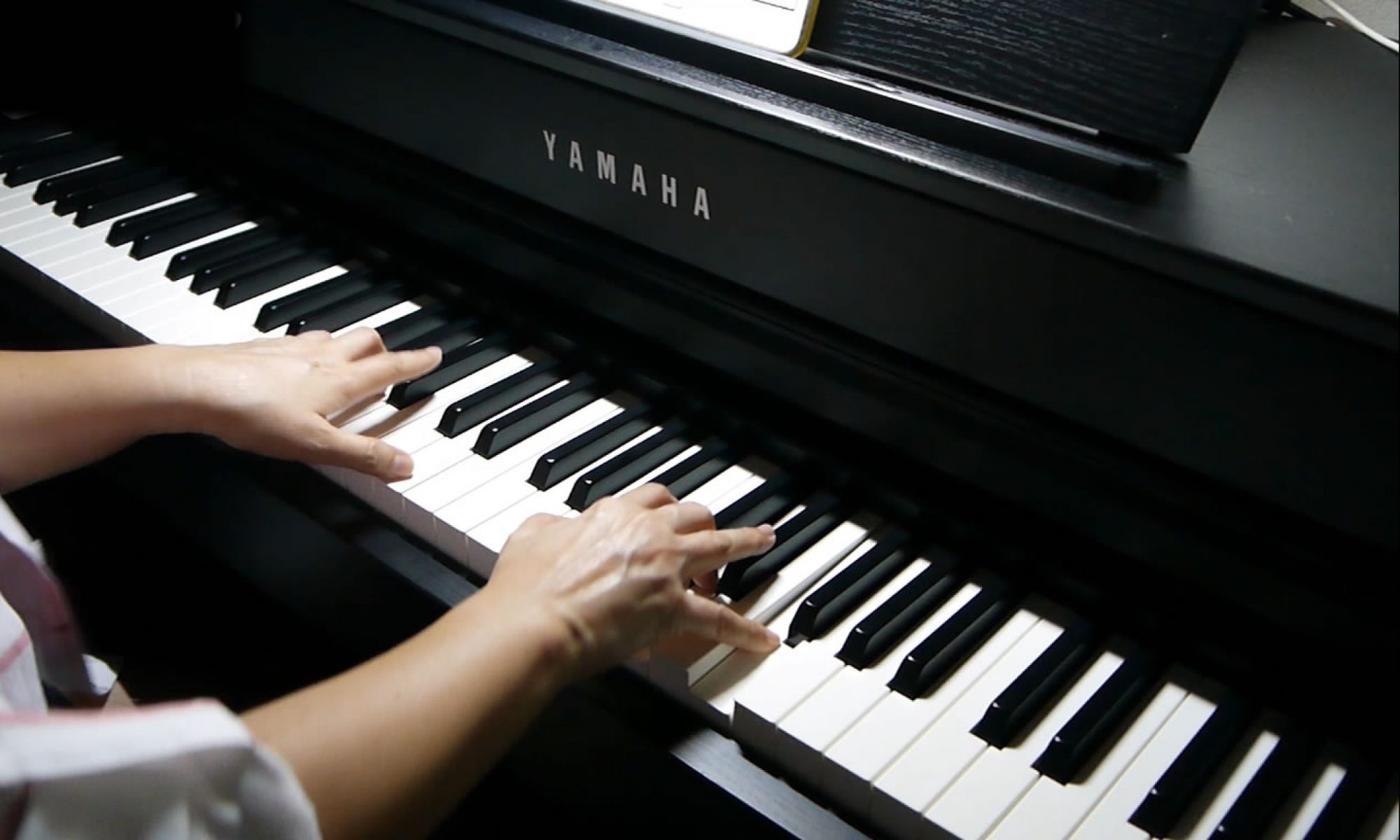
Stay With Me – Sam Smith

This gospel-style influenced song from the debut studio album of Sam Smith (a British singer-songwriter), was released in the UK in May 2014. Many of my viewers have requested it, so I made a cover and sheets for it. Hope you’ll enjoy it!

Sheets here: http://bit.ly/2t3Hu1w
More Sheet Music: http://mnot.es/JLsheets

Learn to play the piano with lots of great music at flowkey: http://tinyurl.com/joyce-flowkey. To find my covers, just type “Joyce” into the search bar.

To view my cover, click
stay

To view the tutorial, click
stay tut

To view the original video, click
stay ori


Like my website? Please support me by clicking on the Donate button below. Thanks!

English sheet music taken down

I deeply regret to have to inform you all that as of 5th August 2014, most of my sheet music for English songs have been removed due to copyright claims by the NMPA (National Music Publishers’ Association). I will still be making covers and tutorials, but only the MP3 files will be available for downloading. Sheets of other music (Kpop, Kdrama and games) are still up. And of course, I’ll keep sharing my thoughts, tips and music-related videos and anecdotes on Blog Posts!

So don’t stop dropping by, ok? 🙂 Your support and encouragement as always, are much appreciated!

For more enquiries, leave a comment or email me at joycemusic1@gmail.com


Like my website? Please support me by clicking on the Donate button below. Thanks!

How to Simplify Arrangements – by ear

If you find any arrangement too difficult and complex for you to play smoothly, you can simplify it yourself. Here are some tips on how to do that:

1) Right Hand – only playing the melody notes in the right hand (that’s usually the top line of notes). Leave out any chord notes that you can’t read easily in time. You can add them in later when you’re better at it, if you want.

2) Left Hand – I always put chord symbols in my scores. That’s so that pianists (and guitarists or organists) can play the accompaniment that they want…without following mine.

You can play:
1. Just the single note shown in the chord (e.g. Cm – just play C note),

2. A block chord if you know the other notes ( Cm = C Eb G all at once)

3. Broken chords or arpeggios if you know how (search YouTube for “how to play arpeggios”)

3) Check out simple tutorials on YouTube for how to play the left hand accompaniment. It doesn’t need to be the song that you want to play. There aren’t that many left hand accompaniment patterns. You can learn to play them by ear 🙂